
The Roaster Behind the Roast: Why Human
Senses Beat a Pre-Loaded Recipe
By Craig & Lori Weyer | Stay Brewed Coffee & Roastery | Saint Anthony, Indiana
Not all small-batch coffee is created equal. That’s a sentence the specialty coffee industry
doesn’t talk about enough — because it cuts close to home for a lot of roasters who’ve invested
in equipment that does more of the work than they’d like to admit.
Here’s the truth: there is a meaningful difference between a roaster who stands at the drum and
reads every batch with their eyes, nose, and ears — adjusting in real time based on what the
beans are telling them — and a roaster who loads a pre-built profile into a computer and lets
the machine execute it. Both can produce coffee. Only one produces coffee that’s genuinely
responsive to what’s actually in the drum that day.
That distinction matters more than most people realize. And it ends up directly in your cup.
What a Pre-Loaded Roast Profile Actually Is
Modern roasting equipment has become increasingly sophisticated. Many roasters —
including some that market themselves as artisan or small-batch — use software that allows a
roast profile to be programmed in advance and then executed automatically. The roaster machine sets
the temperature curves, the airflow, the drum speed, the time at each stage. The machine
follows the instructions. The operator monitors to make sure nothing goes wrong.
This approach has real advantages for consistency and scale. If you’re roasting hundreds of
pounds a day and need every bag to taste identical, automation helps you get there. There’s
nothing dishonest about it — as long as you’re not calling it something it isn’t.
The problem comes when a pre-loaded profile is presented as hand-crafted, artisan, or custom
small-batch roasting. Because what it actually is — is a machine following a recipe written for
a different batch of beans, on a different day, in different conditions. The recipe doesn’t know
what’s in the drum today. Only a human can know that.
Why Every Batch of Green Coffee Is Different
Coffee is an agricultural product. That means it varies — by harvest, by season, by how it was
processed, by how long it’s been resting since it left the farm, by the humidity in your roastery
on any given morning. Two bags of beans from the same origin, the same farm, even the same
harvest can behave differently in the drum depending on moisture content and density.
A pre-loaded profile doesn’t account for any of that. It was written based on a previous roast —
or a sample roast — and it assumes the beans today will behave the same way. Sometimes they
do. Sometimes they don’t. And when they don’t, the machine keeps following its instructions
while the beans quietly go somewhere other than where they were supposed to.
A sensory roaster catches that. Because they’re paying attention.
What Sensory Roasting Actually Looks Like
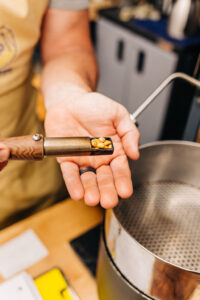
Sensory roasting means being present — fully, actively present — for the entire roast. It means
watching the color of the beans change through the sight glass and knowing from experience
what that color at this stage of the roast means for the flavor that’s developing. It means
smelling the exhaust from the drum and recognizing the shift from grassy to bready to
caramelizing to the first hint of the finish.
It means listening. The first crack — the audible pop that happens as the beans expand and
CO2 releases — is one of the most important moments in a roast. A sensory roaster hears it,
marks it, and makes decisions based on how it sounds and when it arrives relative to the
temperature curve. A machine following a profile hits its programmed end-point regardless.
It means making adjustments in real time: pulling back the heat when development is
happening faster than expected, extending time when a batch needs more, trusting what the
beans are communicating instead of what the computer was told to do.
Craig does this for every batch roasted at Stay Brewed. Not because automation isn’t available.
Because the beans deserve the attention — and so do you.
The Difference You Taste
Coffee roasted by a skilled, attentive human and coffee roasted by a machine following a
pre-loaded plan can both taste fine. On a good day, with consistent beans, the automated roast
might even be indistinguishable from the sensory roast.
But on the days when the beans are denser than usual, or drier, or the ambient temperature in
the roastery is ten degrees warmer than last week — the sensory roaster catches it and adjusts.
The machine doesn’t. And the difference shows up as flatness, as a slightly harsh finish, as
coffee that’s technically correct but missing the thing that makes you stop and appreciate it.
Fresh-roasted coffee that was also carefully roasted — that’s what Stay Brewed is after every
single time. Not just fast. Not just fresh. Right.
Why This Is What Small-Batch Should Mean
The term small-batch has been stretched so far in coffee marketing that it’s nearly lost its
meaning. Technically, any roast below a certain weight qualifies. But the spirit of small-batch
has always been about more than size — it’s about attention. It’s about a roaster who can
actually give every batch the focus it deserves because they’re not trying to process a thousand
pounds before lunch.
At Stay Brewed, small-batch means Craig is at the roaster. He’s watching, smelling, listening,
and adjusting. He’s not supervising a computer. He’s doing the work — the real work — that
turns green coffee into something worth putting in your cup.
That’s what we mean when we say hand-crafted. Not that human hands loaded a bag and sealed
it. That human judgment shaped the roast from start to finish.
Taste the Difference That Attention Makes
Every batch roasted at Stay Brewed is crafted by hand, by Craig, using sight, smell, and sound
— not a pre-loaded recipe. Fresh-roasted in Saint Anthony, Indiana and shipped to your door
within 72 hours. Subscribe and taste what genuinely small-batch actually means.
staybrewed.com/join-the-family