
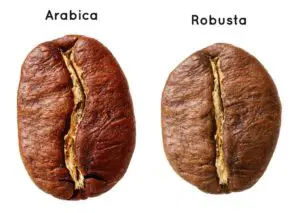
Arabica beans are generally oval, flatter, and feature a curved center crease, while Robusta beans are smaller, rounder, and have a straight center crease.
Arabica vs. Robusta: Why the Bean in Your
Bag Changes Everything
By Craig & Lori Weyer | Stay Brewed Coffee & Roastery | Saint Anthony, Indiana
Most coffee drinkers have heard the word arabica. It shows up on bags, in commercials, on
drive-through signs. What far fewer people know is what it actually means — and why the
difference between arabica and robusta beans is one of the most important quality decisions a
roastery makes.
At Stay Brewed, we use 100% arabica beans. Not as a marketing claim. As a standard we hold
ourselves to because we believe the people drinking our coffee deserve the best raw ingredient
available. Here’s what that means and why it matters.
Two Different Plants, Two Very Different Cups
Arabica and robusta are two distinct species of coffee plant. Coffea arabica and Coffea
canephora — robusta — account for the vast majority of all coffee produced in the world.
They grow differently, taste differently, and serve very different purposes in the coffee
industry.
Arabica plants are finicky. They thrive at high altitudes — typically between 2,000 and 6,000
feet above sea level — in cooler temperatures with consistent rainfall and well-drained soil.
They’re slower to mature, lower-yielding, and more susceptible to disease than robusta. All of
that makes them more expensive to grow and more difficult to source consistently.
Robusta plants are, as the name suggests, tough. They grow at lower altitudes, tolerate heat and
humidity, produce more fruit per plant, and are significantly more resistant to pests and
disease. They’re easier and cheaper to grow at scale. And that cost advantage is exactly why so
much of the world’s commercial coffee supply relies on them.
What the Difference Tastes Like
The flavor gap between arabica and robusta is not subtle. Arabica beans contain roughly twice
the natural sugars of robusta and significantly more lipids — the oils that carry complex flavor
compounds through the brewing process. The result is a cup with sweetness, nuance, and
depth: fruit notes, floral aromatics, caramel, chocolate, brightness, and a clean finish that
lingers pleasantly.
Robusta beans contain nearly twice the caffeine of arabica — and caffeine, in high
concentrations, tastes bitter. Combined with lower sugar content and fewer aromatic oils,
robusta produces a cup that is harsh, flat, and aggressively bitter. Some coffee drinkers have
simply come to accept that bitterness as what coffee tastes like. It isn’t. It’s what robusta tastes
like.
Robusta does have one legitimate use: crema. The higher concentration of certain compounds
in robusta produces a thick, persistent crema in espresso — that golden foam on top of a shot.
For this reason, some espresso blends include a small percentage of robusta deliberately. But
outside of that specific application, robusta is in your cup for one reason: it’s cheaper.
How Mass Producers Use Robusta to Cut Costs
The economics of commodity coffee create enormous pressure to use as much robusta as the
market will tolerate. Robusta beans can cost half as much as comparable arabica on the
commodity market — sometimes less. For a company moving millions of pounds of coffee per
year, that cost difference is enormous.
The result is that a significant portion of the grocery store coffee market — including many
well-known brands — uses robusta either as the primary bean or blended in with arabica to
reduce cost. The label may say “100% coffee” without specifying which kind. It may use the
word arabica on the front while burying a robusta blend in the fine print. It may say nothing at
all about bean variety.
The dark roast profile common in grocery store coffee exists partly to mask this. Roasting
robusta very dark burns off some of the harshest flavors and brings everything to a heavy,
uniform bitterness that reads as bold rather than low-quality. It works well enough that most
consumers never question it. But they’re also never tasting what good coffee actually is.
Why We Only Use Arabica
The decision to use 100% arabica at Stay Brewed was never really a decision — it was a
baseline. When Craig set out to build a roastery worth putting the family name on, sourcing
anything less than the best available bean wasn’t on the table.
Arabica gives us something to work with. The complexity, the sweetness, the range of flavor
that develops through careful roasting — none of that is possible with robusta. When Craig
stands at the roaster and reads a batch with his senses, adjusting heat and airflow to bring out
the best in what’s in the drum, he needs beans that have something worth bringing out. Arabica
does. Robusta doesn’t.
It also means we can’t compete on price with grocery store coffee. We’ve made peace with that.
The customer who wants the cheapest possible caffeine delivery system is not our customer.
The customer who wants to know exactly what’s in their bag, where it came from, and why it
tastes the way it does — that’s who we’re roasting for.
What to Look for on the Bag
When you’re evaluating a coffee — from us or anyone else — here’s what to look for. A bag
that says 100% arabica is making a specific, verifiable claim about the bean variety. A bag that
says 100% coffee is not. A bag that says arabica blend may mean arabica blended with robusta.
A bag that says nothing about bean variety almost certainly has something to hide.
Every Stay Brewed roast is 100% arabica. The roast date is on the bag. The origin is on the
bag. We don’t have anything to hide because we didn’t cut any corners to get to our price point.
What you see is what’s in the bag.
The Subscription Difference
When you subscribe to Stay Brewed, you’re locking in 100% arabica, freshly roasted in
Indiana, on a schedule that means you always have it and never have to settle for whatever’s on
the shelf. That’s not a small thing. Most people spend more mornings than they realize drinking
coffee that was engineered to be acceptable rather than crafted to be exceptional.
You deserve better than acceptable. And now you know exactly why.
100% Arabica. Every Bag. Every Time.
Stay Brewed uses only the highest quality arabica beans — sourced carefully, roasted by hand
in Saint Anthony, Indiana, and shipped to your door within 72 hours of roasting. Subscribe
today and taste what coffee is supposed to taste like.
staybrewed.com/join-the-family